HTTP vs HTTPS

I am a full stack web2 developer. I am in my junior year of college pursuing B.Tech in Artificial Intelligence and Machine Learning.
I have participated in various open source program and activily contributed to multiple projects.
Also I love crystals, coffee, makeup, art and journaling.
What are HTTP and HTTPS?
HTTP: HTTP (Hypertext Transfer Protocol) is a communication protocol used for transmitting data on the internet. It is the underlying technology that allows web browsers to request and display web pages from servers.
It follows a classical client-server model with a client opening a connection to make a request, then waiting until it receives a response. HTTP is a stateless protocol, meaning that the server does not keep any data (state) between two requests. This allows for greater scalability, as the server does not need to store information about the client between requests.
HTTP is an unencrypted protocol, which means that data transmitted using HTTP can be intercepted and read by third parties, making it vulnerable to attacks such as eavesdropping and tampering. For this reason, sensitive information such as personal details or financial information should not be transmitted using HTTP.
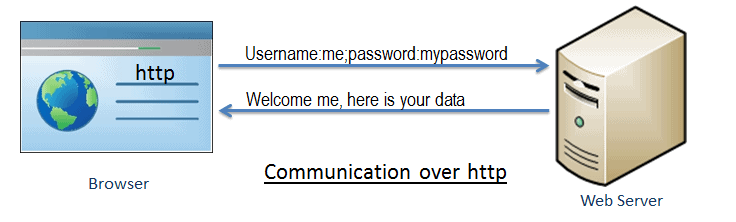
HTTPS: HTTPS (Hypertext Transfer Protocol Secure) is a communication protocol used for secure communication over the internet. It is a secure version of the HTTP (Hypertext Transfer Protocol) protocol, which is used for transmitting data on the internet.
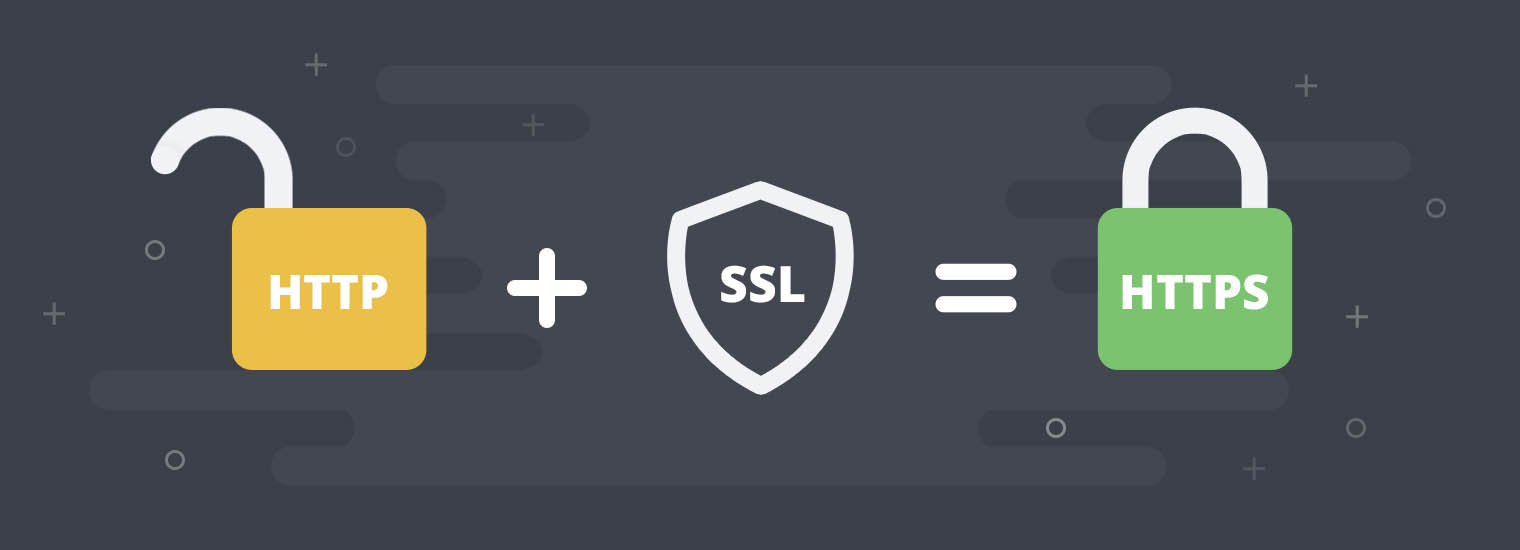
HTTPS encrypts the data being transmitted between a client (such as a web browser) and a server, making it more secure than HTTP, which does not use encryption. This means that the data being transmitted cannot be intercepted and read by third parties, making it less vulnerable to attacks such as eavesdropping and tampering. In addition to encrypting data, HTTPS also provides data integrity. This means that the data being transmitted cannot be altered during transit without the receiver being able to detect the change. This helps to prevent attacks such as man-in-the-middle attacks, where an attacker intercepts and alters the data being transmitted.
Websites that handle sensitive information, such as personal details or financial information, should use HTTPS to protect this information from being intercepted and read by third parties. When a user enters sensitive information on a website that is using HTTPS, the data is encrypted and transmitted securely, ensuring that it cannot be intercepted or read by third parties.
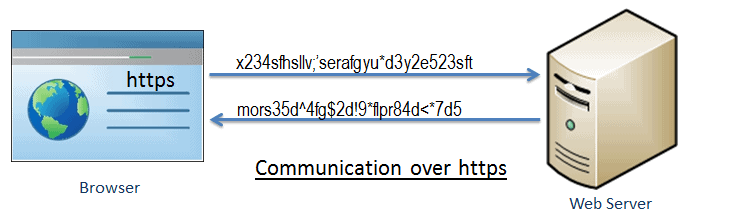
Difference between HTTP and HTTPS:
The main difference between HTTP and HTTPS is that HTTPS provides an additional layer of security by encrypting the data being transmitted. This makes it more secure than HTTP, which does not use encryption.
| Feature | HTTP | HTTPS |
| Security | No encryption, data can be intercepted and read by third parties | Data is encrypted, making it more secure and less vulnerable to attacks |
| Certificate | Not required | Required, issued by a trusted certificate authority |
| Data integrity | No data integrity checks | Provides data integrity, data cannot be altered during transit without being detected |
| URL | Starts with "http://" | Starts with "https://" |
| Port number | Uses port 80 by default | Uses port 443 by default |
| Browser indicators | Doesn't have any padlock icon. | Displays a padlock icon next to the URL of a website. |


